Back to all News

Celebrating twenty years of Occasional Use

Telenor Satellite' Occasional Team celebrates 20 years. Photo: shutterstock_1342547273

For the past twenty years, Space Norway’s Occasional Use team has been helping to bring the world’s most high-profile events into the homes of television viewers around the globe.

Whether breaking news, such as the extraordinary rescue of the Chilean miners caught up in the Copiapó mining accident in 2010, transmitting major sporting events including the London Olympic games in 2012 and 2018 Winter Olympics in PyeongChang, or sharing the grandeur and glamour of royal weddings, our team are an integral part of the broadcasting family.

We go global

Prior to 2001, the business had been focused on the Nordic market, supplying satellite communications for NRK, TV2 Norway, TV2 Denmark, Norkring as well as working with broadcasters in the UK. But following a cooperation agreement with Europe*Star to mutually market capacity on their satellites, Telenor Satellite’s Occasional Use team was able to spread its wings and start offering coverage worldwide.

In fact, the global service got off to a very high profile start as it coincided with the military action in Afghanistan which followed the devasting 9/11 terrorist attacks on the twin towers in New York and other US targets. The demand for satellite links around the world was suddenly enormous. Europe*Star 1 had superb Ku-band coverage from Afghanistan back to the UK and Telenor Satellite was the major reseller of this capacity and, added together with all the contacts within the global broadcast community that our Occasional Use team had developed (including ABC, CBS, NBC, BBC, Sky News, APTN, CNN, ITN, TV2, Al Jazeera), we were in an ideal position to provide this service. In fact, communicating with our customers in dangerous or remote, war-torn zones and providing the support needed is an essential part of the service we provide and is only made possible through the use of satellite technology.

Covering major news events

Over the years we have been present at many of the most significant moments in world news. This has included the tragic Kashmir Earthquake in 2005 where over 80,000 people died and a further 4 million were displaced; the eruption of Iceland’s Eyjafjallajökull volcano in 2010 which brought much of Europe’s air travel to a standstill; the horrific 2011 terrorist attacks on the island of Utøya and the heart of Oslo’s executive government quarter, taking 77 lives; the death of Nelson Mandela in 2013; the trial of Oscar Pistorius in 2014; the catastrophic Nepal earthquake in 2015 that claimed thousands of casualties and left nearly 3.5 million people homeless and providing coverage from world political conferences and summits, including the US elections in 2016, the German elections of 2021 through to the most recent Climate Conference “COP” in 2021.

Present with the Royal family

But alongside the dramatic news events, there have also been lighter moments. It would be fair to say that we have been present with the UK Royal family at weddings, anniversary celebrations, births and more, sharing in the nuptials of Prince William and Prince Harry, celebrating an incredible 60 years on the throne for the Queen in her Diamond Jubilee year and more recently the funeral of Prince Philip, the Duke of Edinburgh.

Sharing the wonders of the world

For the team, some of the most exciting experiences have come from their work in the field of wildlife and geographic documentaries, many of which have been broadcast in a huge number of countries from North and South America, Europe and Asia. These include Wild Alaska Live, Blue Planet, Polar Bear Watch and, for the UK market specifically, Springwatch. In these cases, the logistics of working in remote areas have frequently necessitated a little lateral thinking and it is testament to the relationships we have built up with satellite operators worldwide that we have been able to provide satellite capacity wherever and whenever it has been needed.

Telenor Satellite provided Occasional USe services for BBC & PBS production of “Wild Alaska Live” in 2017. Image: BBC.

Caption: When approached to provide connectivity for the BBC & PBS production “Wild Alaska Live” in 2017, Telenor Satellite’s OU team was eager to get involved in such a unique and challenging project. Photo: BBC.

The result of a collaboration between the BBC Studios Natural History Unit, Cloudbass (wildlife hub), Timeline and Telenor Satellite, Springwatch was one of the few new live productions to be aired during the 2020 pandemic

Caption: The result of a collaboration between the BBC Studios Natural History Unit, Cloudbass (wildlife hub), Timeline and Telenor Satellite, Springwatch was one of the few new live productions to be aired during the 2020 pandemic. Pictured here are presenters Chris Packham and Megan McCubbin on location in Cornwall where internet connectivity is almost non-existent. Photo: BBC.

Facilitating Live-to Cinema

From the early days of Bowie and Met Opera in the mid-noughties through to the recent red-carpet premiere of the latest James Bond film, “No Time to Die”, Live-to Cinema has grown beyond all expectations for content-owners and distributors alike and our OU team has played an active role from the outset. Christopher Bretnall of AOS Productions has been involved in all technical development, production and distribution elements over the last 15 years. He says, “The involvement of Telenor Satellite’s THOR 10-02 OU-inventory has played a huge role in that success. The consistent availability and performance of the OU space has enabled content-owners (including Met Opera, NT Live, ROH, RSC and many other ad-hoc one-off concerts and events) a great freedom to be able to broadcast live to cinema at any time.”

AOS Productions has been involved in all technical development, production and distribution elements of Live-to Cinema. Photo: AOS Productions

Caption: AOS Productions has been involved in all technical development, production and distribution elements of Live-to Cinema. Photo: AOS Productions.
From its satellite, THOR 10-02, Telenor Satellite broadcast the live red-carpet premiere of "No Time to Die" from London’s Royal Albert Hall to international pre-release screenings across Europe. Photo: Telenor Satellite
Caption: From its satellite, THOR 10-02, Space Norway broadcast the live red-carpet premiere of "No Time to Die" from London’s Royal Albert Hall to international pre-release screenings across Europe. Photo: Space Norway.

Sports buffs kept happy

The mainstay of the outside broadcast industry has to be sporting events. Unlike other, one-off happenings, football matches are a regular feature where fans expect nothing less than seamless broadcasting. These matches are interspersed with major world events including the 2014 World Cup in Brazil, Tour de France in 2020, Olympics (both Summer 2012 and Winter 2018) and country marathons.

Politics plays its part

With a history covering more than twenty years, we have seen the arrival, and departure, of many politicians in the UK, Europe and the USA. In the main this has involved wall to wall coverage of major events such as the Trial of Saddam Hussein in 2005-2006, UN Climate Change Conference in Copenhagen in 2009, national elections in Europe and USA, but also the EU Referendum in 2016.

And today the team are looking back over the successful announcement of the new German government which they transmitted. Having supplied satellite links to state broadcaster ARD (from 22 Satellite News Gathering (SNG) trucks located around Germany) when the voting process took place on 26th September, they were very pleased to be an integral part of both processes.

No mission impossible

From our relatively small origins as a regional provider of satellite capacity from our own THOR fleet of satellites, Telenor Satellite’s Occasional Use division is now a major supplier of satellite capacity worldwide, calling on its extensive network of satellite companies to provide the perfect solution for its clients so that they can broadcast anywhere, anytime.

Telenor Satellite's Occasional Use team provided services to BBC and PBS production of “Wild Alaska Live” – three-part series in 2017.
Working in Alaska brings unique challenges to the operational team; with three uplinks and two live broadcasts each day, it was a very complex project which involved more than 140 feeds over the two weeks of testing and filming – and all without a single glitch! Photo: BBC.

Back to all News

Connecting Norway’s oldest and largest square rigged sailing ship Statsraad Lehmkuhl.

Satellite connectivity for Statsraad Lehmkuhl

Connecting the Statsraad Lehmkuhl with state-of-the-art satellite communications was a memorable moment. This achievement brought seamless communication to the high seas, enhancing the capabilities of this historic vessel while preserving its legacy and enabling live broadcasting of a beloved series for NRK.

Connecting Statsraad Lehmkuhl

Broadcasting live for three hours daily over a six-week period is demanding for any broadcaster, so imagine throwing into the mix a different location every day, and all without a fixed land connection.

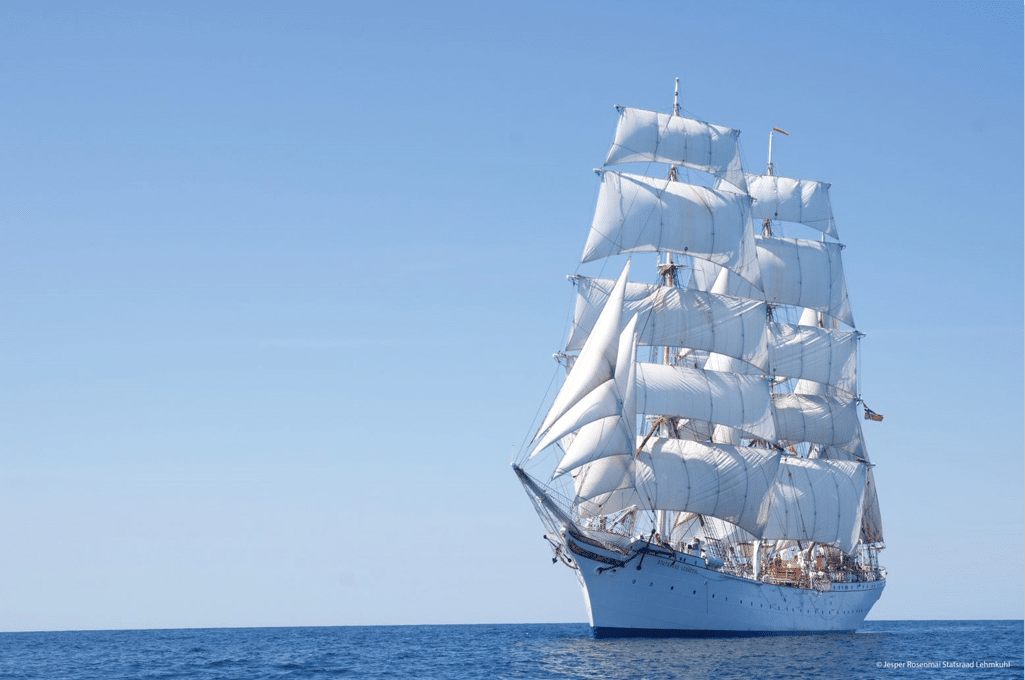
That was the situation for the NRK (Norwegian State Broadcaster) production team based onboard the legendary Statsraad Lehmkuhl as it sailed down the coast from the northern tip of Norway to Bratteklev in the south (with a side trip to Lerwick in the Shetland Islands) during the summer of 2021. Broadcast of “Sommerskuta Minutt for Minutt”- a slow TV show filmed onboard was enabled by the robust satellite communications links provided by Space Norway.


Mobile connectivity – uninterrupted for six weeks

To the delight of thousands of viewers at home, whether dipping in and out of the slow TV show or following it every step of the way, a seamless transmission of the much-awaited program was maintained throughout and supported by Space Norway’s expertise and reliable connectivity.

To ensure uninterrupted streaming, 20/10 Mbps on Ku-band were supplied via THOR 10-02 satellite using the Dialog platform. With this service Statsraad Lehmkuhl was able to use a relatively small maritime antenna to transmit a high bitrate, so neither the aesthetics of the ship nor the quality of transmission were compromised.


Learning the ropes – at sea and at home

As Norway’s oldest sailing ship at 107 years old, Statsraad Lehmkuhl is used to attracting attention wherever it sails. But this summer, the ship, its crew and 30 plus ‘fellow sailors’ selected from the large number of volunteers angling for a chance to sail on this magnificent vessel, were continuously in the spotlight as the ship took in 29 Norwegian ports as well as Lerwick in the Shetland Islands.

While the volunteers were learning the ropes and exercising their muscles hoisting the sails, the production team were making sure that those on land were able to share in the experience from the comfort of home.


A quiet life in the spotlight

“Sommerskuta Minutt for Minutt” followed the ship throughout its journey, giving viewers glimpses of the breath-taking scenery of the Norwegian coastline in real time, while also allowing viewers to experience life onboard a sailing ship, not just the highlights but the ‘minute by minute’ joys and trials of a life at sea.

Also making cameo appearances were well-wishers lending their support from land. People (and dogs!) turned out all along the route for the opportunity to see Statsraad Lehmkuhl and its crew of professional sailors as well as those amateurs who had joined the ship for a first experience of sailing.


Maintaining communications links

While the main focus of the communications links was on the slow TV show, for the crew members and NRK production team it was just as important that they had access to connectivity during their (limited) leisure time and to stay in contact with their families and friends back home. And last, but definitely not least, Space Norway also supplied connectivity to support the operational needs of the vessel throughout its journey.


Watch NRK’s “Sommerskuta Minutt for Minutt 2021


Back to all News

Telenor Satellite's THOR 10-02 makes satellite communications history 36 000 km above the equator.

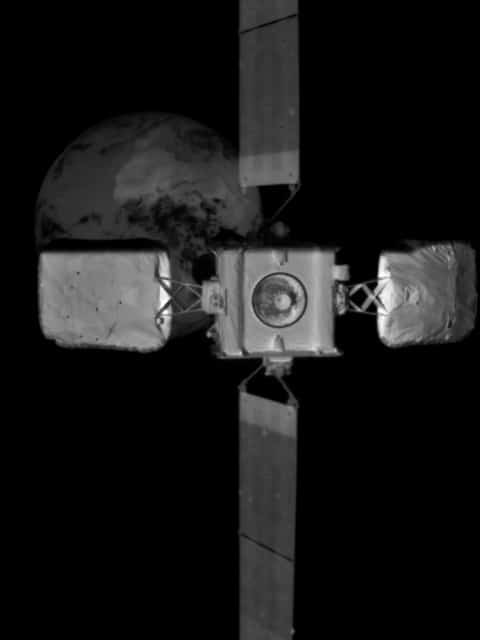
An image of THOR 10-02 / IS-10-02 taken by MEV-2’s infrared wide field of view camera at 15m away. Image courtesy of Northrop Grumman.
Featured image: An image of THOR 10-02 / IS-10-02 taken by MEV-2’s infrared wide field of view camera at 15m away. Image courtesy Northrop Grumman.

Ground-breaking mission in the deepest of space.

Dockings between spacecraft take place on a routine basis, as part of ongoing operations at the international space station. Missions, bringing crew, supplies and fuel, occur regularly at 400 km above the surface of the Earth, where the space station orbits our planet every 93 minutes.

But on April 12, 2021 something truly pioneering took place even further out in space. In fact, almost one hundred times further, 36 000 km above the equator! Here, far above our planet, we made history as Northrop Grumman’s MEV-2 (Mission Extension Vehicle) and our THOR 10-02 satellite docked with each other for the first-ever on-orbit servicing of an active satellite.

Long live THOR 10-02!

THOR 10-02 satellite has been flying in space since 2004, providing vital communication links for broadcasting, maritime and land-based connectivity for parts of Europe and the Middle East. Although the satellite was in excellent health, it was beginning to run out of fuel. This is not unexpected, and before, this would have meant the end of life for a satellite. However, with the help of the latest revolutionary space technology, we can now make sure that our satellite lives on and serves our customers for another five years.

MEV-2 was launched in August of 2020 on board an Ariane 5 rocket from Kourou, French Guinea. Its sole mission was to fly to THOR 10-02, approach it carefully, centimetre-by-centimetre and grab hold of THOR 10-02 to extend its mission life. Simply put, it is an extraordinary achievement to approach and dock while travelling at 3 km/second at 36 000 km above the Earth!

Kudos to all our teammates at Telenor Satellite, partners in Intelsat who operate THOR 10-02 and Northrop Grumman who operate the MEV-2 for this remarkable achievement. Without this success, our THOR 10-02 would have left active service towards the end of 2021 due to running out of fuel. Instead, a new chapter was opened in the life of our satellite.

Arianespace’s fifth mission of 2020 used an Ariane 5 with increased payload capacity, resulting from the integration of a new vehicle equipment bay. Flight VA253. Galaxy 30, MEV-2 and BSAT-4b.

Arianespace’s fifth mission of 2020 used an Ariane 5 with increased payload capacity, resulting from the integration of a new vehicle equipment bay. Flight VA253. Galaxy 30, MEV-2 and BSAT-4b. Décollage champ large, le 15/08/2020. | Wide view lift-off. 08/15/2020. Image courtesy Arianespace.

So what’s so special about the GEO orbit?

This is where we find the geosynchronous satellites used for all kinds of communication, observation and navigation missions. As we all know, the earth revolves around its axis in 24 hours. What you perhaps didn’t know is that satellites in the geosynchronous orbit travel around their orbit in exactly the same time. This means that a satellite in the GEO orbit follows the rotation of the Earth, and the satellite, therefore, appears to stay fixed with respect to Earth.

This property is enormously important, since it allows for the installation of the small, inexpensive parabolic antennas that we are so used to for receiving satellite television. Hundreds of TV-channels are available to watch with no cables, only a small antenna dish on your wall. And for our maritime clients, this means robust connectivity for their business-critical operations at sea.

Together, no mission is impossible.

We are proud to be part of this revolutionary mission, making satellite communications history together with our talented and dedicated colleagues and trusted partners.

Intelsat, co-owner and operator of IS-10-02 /THOR 10-02.

Northrop Grumman, developer and operator of the MEV-2.

Back to all News

Telenor Satellite and Intelsat to add new 4K/UHD (Ultra High Definition) channels to key regions across Europe.

4K/UHD broadcast services distribution
Telenor Satellite introduces 4K/UHD channels to the Nordics and Central Eastern Europe

Telenor Satellite and Intelsat are extending their longstanding partnership at 1° West to expand 4K/UHD (Ultra High Definition) channel distribution to Nordic and Central Eastern European (CEE) countries, and introducing it directly into the homes of nearly 18 million Pay TV households in the region.

The Telenor Satellite and Intelsat 1° West media distribution solution is an ideal platform for 4K/UHD, which offers the best quality picture for viewers. The Telenor Satellite-Intelsat partnership at 1° West is already helping broadcasters in the region reach a much larger audience, across a broader geographic area, when broadcasting 4K channels.

Now, the companies are introducing new 4K/UHD channel distribution. First channels to be offered include NASA TV and WOW 4K, with additional channels coming soon. The new 4K channels will be broadcast to CEE and Nordic region viewers on Telenor Satellite’s THOR 7, and Intelsat will do the same for CEE viewers using Intelsat 10-02.

“We are delighted to welcome broadcast channels such as Wow 4K and NASA 4K to be distributed via our 1° West satellite fleet, with 4K content enhancing the viewing experience even more,” said Ole Ledang, Director of Broadcasting Division at Telenor Satellite.

“We know that viewers’ expectations are growing when it comes to user experience. They are looking for a high-quality, high-resolution image, and they also want access to more diversified content. Working with Telenor Satellite, we are making it possible for broadcasters to meet their viewers’ needs in the Nordics, the CEE regions and neighbourhoods that we are already addressing through 1° West,” said Olivier Herson, Managing Sales Director at Intelsat.

Back to all News

How to build a satellite

Preliminary design review and critical design review

One of the first important milestones in a satellite project, is the Preliminary Design Review (PDR) and later Critical Design Review (CDR).

Satellites are still no run-off-the-mill product, and very few satellites are mass produced. Even the most common communication satellites and weather satellites are built one at time or in very few numbers and still they are moderated and adapted during production. Satellite projects are known for their considerable technical and economic risk. Our ASBM satellites are very large and very complex, and this means that even if the base principles are set, everything must be built from scratch.

The first thing to do as a customer is to send a Request for Proposal (RfP) to several satellite suppliers, detailing what kind of payloads will be on board, what kind of functionality is expected and other specific demands. In 2019, Space Norway selected Northrop Grumman as the ASBM supplier, and the design work started immediately.

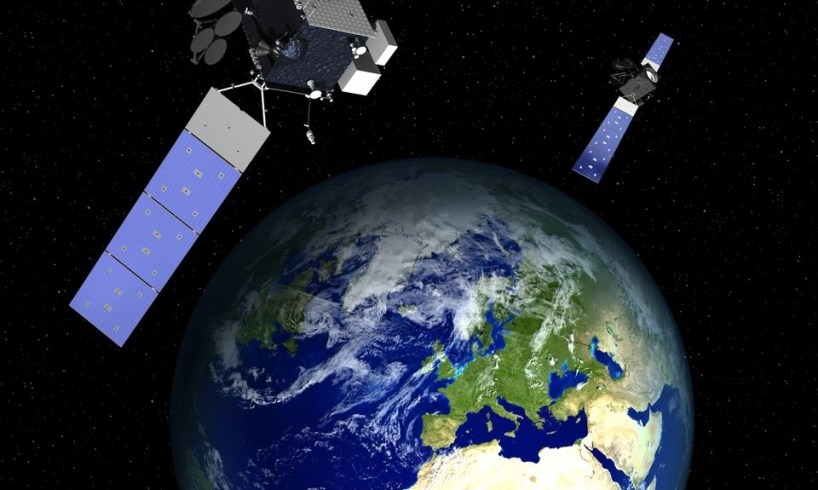
Our satellites are communication satellites, meaning that the payloads consist of radio equipment for receiving signals from the ground and returning signals down to Earth. Because the satellites’ orbits go far out in space in its highly elliptical path, vast land areas are covered by the payload radios. The unique thing about the ASBM satellites is that one satellite alone delivers radio coverage all over the Arctic, and one satellite will always be visible over this area.

On board, antennas for both receiving and transmitting signals, signal filters that eliminate unwanted noise as well as a number of amplifiers are found. The amplifiers enhance the signals that are picked up from the ground before they are sent back down. Simplified, one could say that they pick up a whisper and shout it in return. The return signals are down converted in frequency to avoid interference to the receiving antennas on board the satellite.

All this activity demands power, and the power is produced by the large solar panels and large battery banks that ensure that the equipment functions when the satellites are not exposed to the sun. Temperature control ensures that everything functions on board under as normal as possible conditions even when the outside temperature varies between very cold and very hot. All these elements are tailor made to cover the specific demands that are made by the programme. Additionally, there is always a margin, and for the life span of a component, this will typically be around 50% performance above the need.

The first design phase ends with a preliminary design review, a PDR, where the supplier presents its suggestion for how the satellite would look and be built. It will display the placement of each component and unit, specify the performance each sub system would have, how to operate the satellites and so on. The PDR for ASBM was carried out in February 2020. After this point, it is still possible to make changes to the design, and the design is continually evaluated. Adjustments are made, mostly together with the suppliers of the payloads and this phase usually takes about one year.

Once all these important decisions are made, there is the critical design review, a CDR. For ASBM, the CDR was in August of 2020. Here, the final design is agreed upon, and further changes are not made. No further functionalities are added, and no more units are added to the satellite. CDR locks the design and construction, and building commences.

Back to all News

Preliminary and Critical Design Review

How to build a satellite

One of the first important milestones in a satellite project, is the Preliminary Design Review (PDR) and later Critical Design Review (CDR).

Satellites are still no run-off-the-mill product, and very few satellites are mass produced. Even the most common communication satellites and weather satellites are built one at time or in very few numbers and still they are moderated and adapted during production. Satellite projects are known for their considerable technical and economic risk. Our ASBM satellites are very large and very complex, and this means that even if the base principles are set, everything must be built from scratch.

The first thing to do as a customer is to send a Request for Proposal (RfP) to several satellite suppliers, detailing what kind of payloads will be on board, what kind of functionality is expected and other specific demands. In 2019, Space Norway selected Northrop Grumman as the ASBM supplier, and the design work started immediately.

Our satellites are communication satellites, meaning that the payloads consist of radio equipment for receiving signals from the ground and returning signals down to Earth. Because the satellites’ orbits go far out in space in its highly elliptical path, vast land areas are covered by the payload radios. The unique thing about the ASBM satellites is that one satellite alone delivers radio coverage all over the Arctic, and one satellite will always be visible over this area.

On board, antennas for both receiving and transmitting signals, signal filters that eliminate unwanted noise as well as a number of amplifiers are found. The amplifiers enhance the signals that are picked up from the ground before they are sent back down. Simplified, one could say that they pick up a whisper and shout it in return. The return signals are down converted in frequency to avoid interference to the receiving antennas on board the satellite.

All this activity demands power, and the power is produced by the large solar panels and large battery banks that ensure that the equipment functions when the satellites are not exposed to the sun. Temperature control ensures that everything functions on board under as normal as possible conditions even when the outside temperature varies between very cold and very hot. All these elements are tailor made to cover the specific demands that are made by the programme. Additionally, there is always a margin, and for the life span of a component, this will typically be around 50% performance above the need.

The first design phase ends with a preliminary design review, a PDR, where the supplier presents its suggestion for how the satellite would look and be built. It will display the placement of each component and unit, specify the performance each sub system would have, how to operate the satellites and so on. The PDR for ASBM was carried out in February 2020. After this point, it is still possible to make changes to the design, and the design is continually evaluated. Adjustments are made, mostly together with the suppliers of the payloads and this phase usually takes about one year.

Once all these important decisions are made, there is the critical design review, a CDR. For ASBM, the CDR was in August of 2020. Here, the final design is agreed upon, and further changes are not made. No further functionalities are added, and no more units are added to the satellite. CDR locks the design and construction, and building commences.

Back to all News

ASBM

Landing rights in the US

One of the first things that must be done when you plan for a satellite launch, is to consider the countries the satellite will fly over when in orbit.

It is the satellite’s area of coverage that is important. When Space Norway decided to establish broadband mobile communication to the Arctic using two highly elliptical satellites, applications to the UN’s International Telecommunication Union (ITU) were made. The ITU is an entity for coordination seeking international coexistence, but without sanctioning powers over nations. The filing with the ITU secures, in general terms, the utilization of necessary frequencies for satellites in their specified orbits. The ITU has the complete overview over all spectrum filings, what it may be used for and what it actually is used for. Space Norway’s filings registered with the ITU is the first stop on the way to being able to use the frequencies on the satellites’ payloads.

Each country has its own national organization that coordinates the satellite operators’ filings with the ITU. In Norway, this is administered by the National Communications Authority (Nkom). The Nkom keeps track of all frequency use in Norway and has a national coordination role.

Some countries have organizations with more authority than others, for example the USA and Canada – and both countries are important for Space Norway’s Arctic broadband satellites since permission to use the systems in each country must be obtained. The telecommunications authority for the US is the Federal Communications Commission (FCC). Back in 2017, an application was submitted and later that same year, a conditional permission was granted. The condition was that an agreement be reached with all other satellite operators. This means that the real work begins with this permission. A satellite operator must make sure that their signals do not interfere with other signals and the other way around. See this article about this very demanding process. Space Norway immediately started dialogue with operators in the US (and the rest of the world) to analyze coexistence. For the US, this included for example SpaceX, with a very high number of satellites in low earth orbit, being one of the operators. Now, several years later, agreements have been made with SpaceX, One Web and Amazon, while some operators still remain. The FCC is an enforcing agency, and all operators with landing rights must pay a bond up to USD 5M. Operators that are not operational within six years after receiving permissions, risk loosing this bond. This is done to prevent spectrum harvesting, meaning that the very limited frequency resources are bound by systems not being built or put into operation. The way the US organizes this, is different from most other countries, but then nowhere else in the world is the activity level as high regarding the need for frequencies as in the US.

Landing rights are not needed in the EU, including Norway, but the need to manage frequencies is the same, and the ITU regulated coordination is done in dialogue with each country’s administration or with each operator.

As for some of the other countries in the Arctic, landing rights are needed for ASBM also in Canada, which was achieved when coordination with all relevant Canadian satellite operators were in place.

Back to all News

Bringing live transmissions out of the most isolated parts of Alaska.

Live transmissions from Alaska

When BBCOB Comms and Timeline-TV approached us about getting connectivity out of some the remotest parts of Alaska for the amazing BBC programme Wild Alaska Live, the Telenor Satellite’s OU team’s motto “No Mission Impossible” kicked in.

Telenor Satellite was faced with the challenge of finding several Ku-band satellites with coverage over Alaska with connectivity to the US and UK.

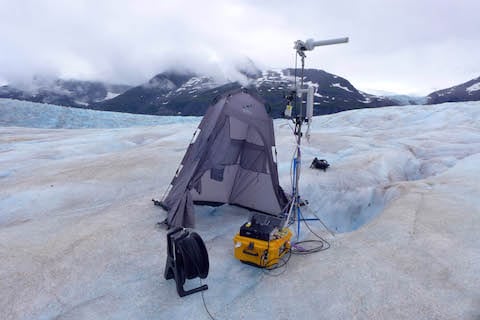
Multiple paths were required out of four locations, as well as reverse vision feeds to enable the main studio to keep in touch with the remote sites. One of the locations where a small studio & uplink was located, Katmai National Park, only source of power were batteries, charged by solar panels and hydrogen fuel cells. Even with state of the art SSA’s this limited the up-link to 50W. Telenor was faced with the challenge of finding a satellite “hot” enough to get the job done. As well at satellite coverage, fibre was used to provide the transatlantic connectivity to and from the US.

Live broadcasting from Alaska
Our OU team relished the challenge of being involved in something so exciting and unique.

“Telenor definitely had the easier job, coordinating the coverage from the office, compared to the operational team working in challenging conditions in Alaska”, commented Zara Evans, Bookings Manager at Telenor Satellite. Over the two weeks testing and filming, Telenor booked over 140 feeds, all without a single glitch.

Coverage took place in various venues across Alaska, from the world’s largest temperate rainforest, Tongass National Forest, to the Katmai National Park.

“The Alaska project was very complex with three uplinks in Alaska for sending content into the hub and for two live broadcasts each day for UK & US viewers.  We depended on Telenor to find the right satellite capacity to make it all work. The booking team at Telenor Satellite are so efficient and coped really well with loads of changes, three time zones and varying channel bandwidths. There were a lot of things to worry about on Wild Alaska Live but thanks to Telenor, sat space was not one of them” commented Nick Buckley, Head of Operations at Timeline Television.

“At the Main Site we had connectivity requirements far in excess of just pictures and sound! With a live show centred on animals appearing for us, “on cue”, nothing stayed the same for long! We felt totally supported by Telenor Satellite with the many daily changes we requested to them. They also helped the project by installing an interest in our programme with the Satellite owners who then found it easier to accept some of our non-standard workings!” commented Chris Cobb, Vice Chairman of BBC OB-Comms Ltd.

Telenor Satellite's Occasional Use team provided services to BBC and PBS production of “Wild Alaska Live” – three-part series in 2017.
Working in Alaska brings unique challenges to the operational team; with three uplinks and two live broadcasts each day, it was a very complex project which involved more than 140 feeds over the two weeks of testing and filming – and all without a single glitch! Photo: BBC.

Wild Alaska Live was a major three-part series event for BBC One, produced by BBC Studios’ Natural History Unit and co-produced by PBS.